You Already Know This Feeling. Now There’s a Name for It.
You were not imagining it. And you are not alone.
Most of us move through the world as though we are watching it through a pane of glass.
The glass is barely visible. It lets the light through. But it keeps us away from something we used to feel more closely. Maybe in childhood, when the smell of rain on dry earth was enough. Or when light through leaves was truly worth stopping for.
The glass is made of the beliefs, worldviews, and ideologies we have accumulated in order to explain the world rather than experience it. Most systems hand you more glass. Better glass. Glass with a framework etched into it. And then they send you out to look through it.
Domei works the other way.
The experience comes first. Whatever arrives belongs entirely to you. You can interpret it through your own worldview, or through none at all.
What you find there is yours.
There is a quality of attention older than any practice, older than any tradition.
It is not something you need to learn. It is something you were born with.
A child crouches over a beetle for twenty minutes, completely absorbed, going nowhere. Then someone pulls them away. Over time, the crouching stops. The beetle becomes part of the blur.
The living world becomes background. We move through it too fast, always on our way to somewhere else, and stop noticing it is there at all.
The world we have built rewards a different kind of attention – fast, extractive, indifferent to what is already here. That is all that happened. Nothing broke.
But the living world has not moved.
It is still here. In the plant on your windowsill. The weed at the edge of the car park. The tree you pass every morning without stopping. Present, unhurried, asking nothing of you.
Domei does not ask you to study the living world, or revere it, or understand it.
It asks you to recognise it – as the oldest company you have kept. The one place you can arrive in your darkest moments or your most exhilarating ones and feel no judgement. Only the quiet, steady presence of something that has always been here and always will be.
Not above you. Not below you.
Alongside you.
That is what kin means.
There are no initiations here. No beliefs to adopt, no lineage to join, no special place you need to travel to.
Each practice is short and plain. You read it. You do it. You see what happens.
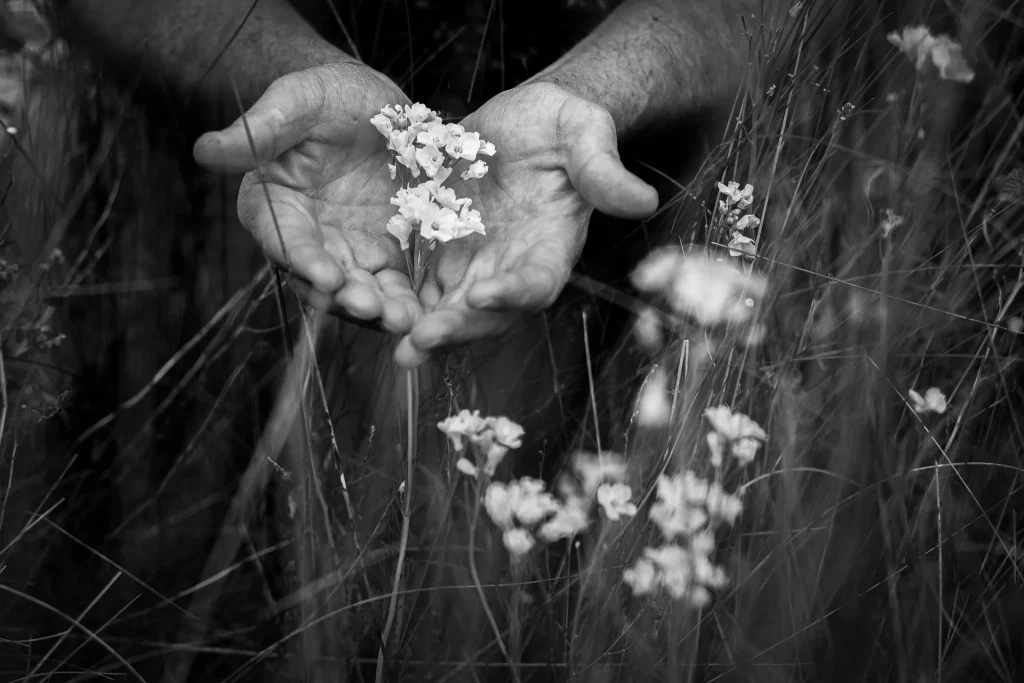
Find a plant. Sit with it for five minutes. Give it your full, unhurried attention – not to study it, not to identify it, just to be with it.
A Christian will return with different words than an atheist. Someone carrying grief will notice different things than someone carrying joy. That is not a flaw in the practice. That is the point.
Over time, something tends to shift. Not dramatically, and not all at once. The way light changes in a room when a cloud moves – you did not see it happen, but the room is different.
That shift is yours too.
You are not the first person to arrive here carrying something you could not name.
A moment near a tree. A garden in winter. Something that settled in you briefly and then passed, leaving only the faint sense that it had meant something – something real, that you did not know what to do with.
Most people keep these moments private. The existing language for them belongs to traditions that do not quite fit – frameworks and belief systems you would need to adopt before you could even begin. The reverence you felt was real. The container was the problem, not the experience.
You do not need to arrive prepared. You just need to arrive.
You are not unusual for having felt what you felt.
You were simply waiting for a place that started where you already are.
I have been working with plants since my early forties. But Domei did not come from study.
It came from a moment in my twenties when the floor of my worldview gave way during a contemplative session. Everything I believed, gone. I walked away from the Church I was training for and kept only one thing – the practice of returning attention to what was actually present.
A chronic drug and alcohol addiction arrived in the middle of the years I was already teaching plant knowledge. It lasted the better part of a decade. The practice did not prevent it. But it was there at rock bottom when nothing else was. Not as philosophy. As solid ground.
By fifty I was clean and sober.
The plants had been there the whole time. Steady. Unhurried. Asking nothing except attention.
My name is Robin Harford. I have been teaching plant knowledge and foraging for over twenty years. Domei is what all of it became.
If something on this page has felt familiar – not new, but recognised – there is somewhere to go next.
Once a week, every Thursday at 8am, a quiet space arrives in your inbox. No algorithm deciding what you see, no feed pulling you elsewhere. Just the Domei Newsletter – a contemplative space for people who sense there is a different way of inhabiting the world and want to explore it.
The practices themselves are a different and deeper invitation, there when you are ready.
For now, just this.
No obligation. No urgency. Leave whenever you want.